 +38 (050) 777 03 93
Loading Ramps
Loading Ramps – A Reliable Assistant for Your Warehouse
Loading ramps are the optimal equipment for efficient logistics management at industrial facilities. They provide convenient access for forklifts to loads in truck beds, railway cars, or containers, significantly speeding up loading and unloading operations. Dolever’s loading ramps are designed to maximize productivity, minimize time costs, and ensure safe operations. Thanks to durable materials and well-thought-out design, they are the ideal solution for warehouses, logistics centers, manufacturing facilities, and other sites where cargo must be efficiently transferred between different levels or types of transport.
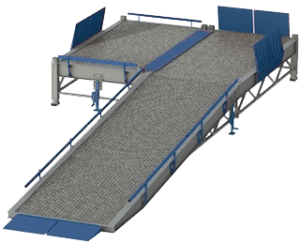
Transloading Ramp (Modular) Dolever
from 200000 ₴
Transloading Modules (Ramps) Dolever
from 165000 ₴
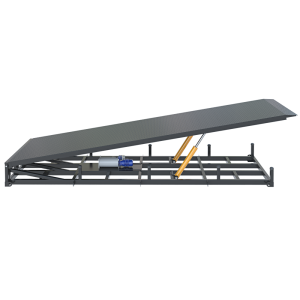
Hydraulic Transloading Ramp Dolever
from 168000 ₴
Dolever Transloading Ramps
from 250000 ₴
Looking for a high-quality and reliable ramp? Then you should explore the range of Dolever mobile ramps.
Main Types of Equipment
Dolever offers a wide selection of loading ramps, including:
- Modular loading ramp: Hydraulic or mechanical height adjustment (850-1650 mm), load capacity – up to 50,000 kg.
- Modular dock ramp: Adaptive design with custom dimensions, load capacity – 6,000 to 50,000 kg.
- Hydraulic ramp: Platforms ranging from 6000-12000 mm in length, width up to 2400 mm; an optimal solution for large loads up to 20,000 kg.
- Stationary loading ramp: Designed for any type of transport, surface made with a grating for reliable traction.
Applications
Dolever mobile loading ramps are used in a wide range of industries. They perform effectively in warehouse complexes, distribution centers, and production zones where speed and precision in loading and unloading operations are critical. In seaports and railway terminals, they provide reliable cargo transfer between platforms of varying heights. On construction sites, ramps enable fast movement of heavy materials and machinery, enhancing overall safety and reducing risks for personnel.
Price and Warranty
The price of mobile warehouse ramps is calculated individually. Key pricing factors include load capacity, dimensions, ramp type, and additional options such as the type of lifting mechanism or surface coating. All products undergo technical inspection during manufacturing and come with complete documentation. The warranty confirms the reliability of every component.
Order your Dolever mobile loading ramps today to equip your business with powerful, durable, and efficient logistics equipment. Our experts will develop a technical solution, provide consultations, and support your project from planning to deployment.
Reliability and efficiency – that’s Dolever.
FAQ
Ramps are convenient for mobile use, but a fixed dock is necessary when logistics are stable and continuous. Industrial complexes, distribution centers, or facilities with large trucks and railcars achieve higher efficiency with stationary structures. Dolever loading docks allow safe handling of multi-ton cargo and equipment without relocating devices.
Yes, Dolever docks are designed with vehicle parameters in mind. Thanks to hydraulic or mechanical height adjustment (850–1650 mm), they can service both light trucks and heavy trailers. Modular solutions allow adjusting platform width and length for specific needs.
Installation time depends on the complexity of the structure and site preparation. Typically, installation of a Dolever fixed dock takes several days, including foundation work and node testing.
All Dolever docks are made of steel with anti-corrosion coating, ensuring durability even in harsh operating conditions. Protection is achieved through special paint coatings and hot-dip galvanization of certain elements. This allows outdoor use – in ports, rail terminals, or construction sites. Regular inspections and touch-up painting protect the metal from aggressive environments for years.
A fixed dock significantly reduces logistics operation time. It provides direct forklift access to trucks and containers without additional devices or temporary structures.